
Wheel Nut Torque Chart
Look up typical wheel nut (lug nut) torque ranges by stud thread size, convert between foot-pounds, newton-metres and kilogram-metres, and print the correct star tightening pattern for your wheel. Your vehicle manufacturer's specification always comes first.
- Free to use
- No sign-up
- Runs in your browser
Wheel nut torque tools
Tightening pattern
Typical lug nut torque by thread size
| Stud / thread size | Typical application | Typical torque (ft-lb) | Typical torque (N·m) |
|---|---|---|---|
| M10 × 1.25 | Small older cars, some motorcycles/ATVs | 40–55 | 55–75 |
| M12 × 1.25 | Many Japanese cars (e.g. some Nissan, Subaru, Suzuki) | 65–90 | 88–122 |
| M12 × 1.5 | Many Japanese, Korean and European cars | 75–100 | 100–135 |
| M14 × 1.5 | Many European cars, SUVs and pickups | 90–140 | 120–190 |
| M14 × 2.0 | Some older European models | 85–110 | 115–150 |
| M16 × 1.5 | Heavier SUVs and vans | 120–170 | 160–230 |
| 7/16"-20 | Older US cars | 70–80 | 95–110 |
| 1/2"-20 | Many older US cars and light trucks | 75–100 | 100–135 |
| 9/16"-18 | Heavier US trucks and trailers | 110–150 | 150–205 |
| 5/8"-18 | Some heavy-duty pickups and trailers | 130–175 | 175–235 |
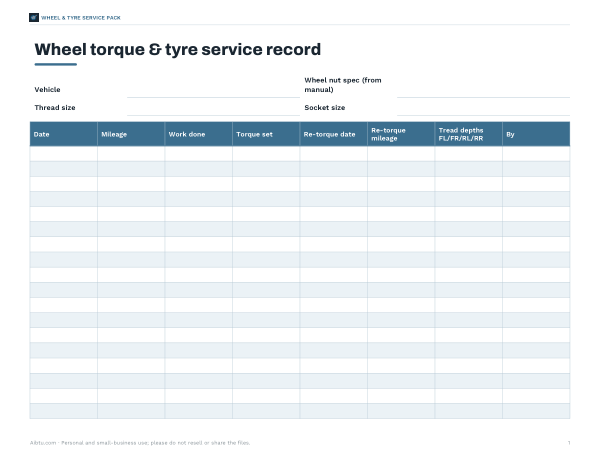
Wheel & Tyre Service Pack
A printable wheel torque record, star-pattern diagrams, a torque conversion card and a tyre rotation log for your vehicles.
- Torque record & tyre rotation log (PDF, DOCX, XLSX)
- Torque conversion card (PDF, XLSX)
Formats: PDF, DOCX, XLSX. Instant download after payment (link valid 72 hours, up to 5 downloads). AI-assisted: the templates were drafted with AI help and reviewed and laid out before publishing.
$5.00 USD, one-time
- Instant download
- 7-day refund
- Secure checkout by Stripe
7-day money-back guarantee. Full refund within 7 days of purchase, even after you download.
Full refund within 7 days — see the refund policy and license.
Free printables
Single sheets you can print right now, no sign-up. The full pack adds every sheet in one download plus the editable files.
Why wheel nut torque matters
Wheel nuts hold the wheel against the hub by stretching the wheel studs slightly, like very stiff springs. The clamping force comes from that stretch, and torque is how we control it. Too little torque and the nuts can loosen, the wheel can shift, and in the worst case it can come off. Too much torque can stretch or break studs, damage threads, distort brake rotors or drums, crack alloy wheels, and make the nuts almost impossible to remove at the roadside. Using a torque wrench set to the manufacturer's value is the only reliable way to get it right.
Where to find the correct torque
- The owner's manual, usually in the specifications or tyre-changing section.
- The workshop or service manual for your exact model and year.
- The aftermarket wheel manufacturer's instructions, which may specify a different torque or seat type.
- A dealer service department or a reputable tyre shop, using the vehicle's published specification.
The chart on this page shows typical ranges for common thread sizes so you can sense-check a number and choose a suitable torque wrench, but specifications vary by vehicle, stud grade, wheel material and nut design. When they differ, the manufacturer's figure is correct.
Converting torque units
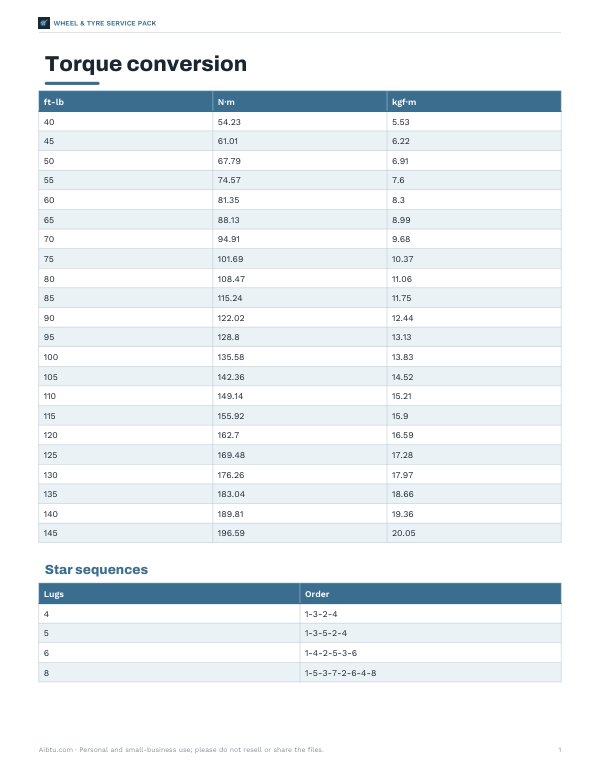
Torque specifications appear in several units. The converter above uses these factors:
| From | To | Multiply by |
|---|---|---|
| ft-lb | N·m | 1.3558 |
| N·m | ft-lb | 0.7376 |
| kgf·m | N·m | 9.8067 |
| N·m | kgf·m | 0.1020 |
| in-lb | ft-lb | ÷ 12 |
For example, 100 ft-lb is about 136 N·m, and a European specification of 120 N·m is about 89 ft-lb. Many click-type torque wrenches show both scales on the handle.
The star pattern
Tighten wheel nuts in a star or criss-cross sequence, moving across the hub rather than around it, so the wheel is pulled evenly onto the hub face. The diagram shows the order for 4, 5, 6 and 8 lug wheels. A good procedure is: thread all nuts by hand; snug them in the star order with the wheel just touching the ground; lower the vehicle; tighten to about half the final torque in the same order; then go round again to full torque. Stop when the wrench clicks — do not keep pulling.
Re-torque after installation
Many tyre shops and wheel manufacturers recommend checking torque again after the first 50 to 100 miles (80–160 km), because wheels can settle slightly on the hub, especially with new alloy wheels or after rust or paint was removed from the mounting faces. Heavy-duty and trailer wheels often have specific re-torque intervals. Check the torque with the same star sequence and a correctly set wrench.
Good practice for wheel changes
- Clean rust and dirt from the hub face and the back of the wheel so it sits flat.
- Use the correct nuts: conical (60°), ball (radius) and flat-seat nuts are not interchangeable.
- Do not lubricate threads unless the manufacturer says so; oil changes how torque translates to clamping force and can lead to over-tightening.
- Never use an impact wrench for final tightening; use it at most for running nuts on, then finish with a torque wrench.
- Replace studs or nuts with damaged threads.
- Store your torque wrench at its lowest setting and have it checked periodically for accuracy.
Worked example
Your owner's manual specifies 108 N·m for a car with M12 × 1.5 studs. The converter shows that is about 80 ft-lb, within the typical range for that thread size in the chart. With a five-lug wheel, you snug the nuts in the order 1-3-5-2-4 around the star, lower the car, tighten to about 40 ft-lb in the same order, then to 80 ft-lb. After 50 miles, you check each nut again at 80 ft-lb.
Choosing a torque wrench
For passenger cars, a 1/2-inch-drive click-type torque wrench covering roughly 20–150 ft-lb (about 30–200 N·m) handles almost every wheel. Trucks with larger studs may need a wrench reaching 200 ft-lb or more. Wrenches are most accurate in the middle of their range, so pick one whose range comfortably covers your specification rather than one where your value sits at the very end. Torque sticks for impact wrenches limit output but are not a substitute for a calibrated wrench on the final pass.
Frequently asked questions
What is the typical lug nut torque for a car?
Many passenger cars specify roughly 75–100 ft-lb (100–135 N·m), but always check your manual.
How do I convert ft-lb to N·m?
Multiply by 1.3558. 80 ft-lb ≈ 108 N·m.
Should I oil wheel studs?
Not unless the manufacturer specifies it. Lubrication can cause over-tightening at the same torque setting.
Why re-torque wheels?
Wheels can settle on the hub after installation; checking after 50–100 miles confirms the clamping force.
Can I use an impact wrench?
Use it only to run nuts on. Final tightening should be done with a torque wrench.
Are aluminium wheels torqued differently?
They may use different nuts and specifications. Follow the wheel or vehicle maker's instructions.